
Infrastructure assets
Infrastructure & Technology
Everything on this site exists to answer one question. Can it deliver the same electricity at three in the morning in February as it does at noon in June? Equipment is the easy half of that answer. The connection, the geology underneath and the way the parts are arranged around each other are the half that takes nine years.

One connection, asked to do six things
The campus is before the Independent Electricity System Operator as a single facility that both generates power and consumes it. That dual classification is not an accident of paperwork. It is the design: one point of connection, four assets behind it, a continuous load beside them, and the ability to run several of those modes at the same time.
From that one connection the site is built to supply:
- Flexible demand. Charging absorbs power the grid cannot otherwise place.
- Long-duration storage. Eight hours at 500 megawatts, and a three-day emergency reserve at 75.
- Firm dispatchable capacity. Full output within about ten minutes of a call.
- Fast response. Frequency, voltage and reactive support in the seconds and minutes.
- Black start. The ability to come up with no grid behind it.
- Export. Up to 1,000 megawatts into the provincial system.
Black start earns its own sentence. Once there is air in the reservoirs the plant can start with no outside power at all and run independently – which puts it on a short list of resources capable of helping restore a region after a wide-area outage. Very few assets in Ontario can make that offer, and none of the ones that can is also a large continuous load.
A site that can generate, store, consume and export at the same time is not a power plant with a customer attached. It is one piece of infrastructure doing four jobs, and the grid sees the net.
Storage that uses geology instead of building it
Compressed air energy storage usually begins with an excavation. A cavern has to be mined or solution-mined before a single kilowatt-hour can be put away, and that excavation is both the largest cost in the technology and the largest thing that can go wrong with a schedule.
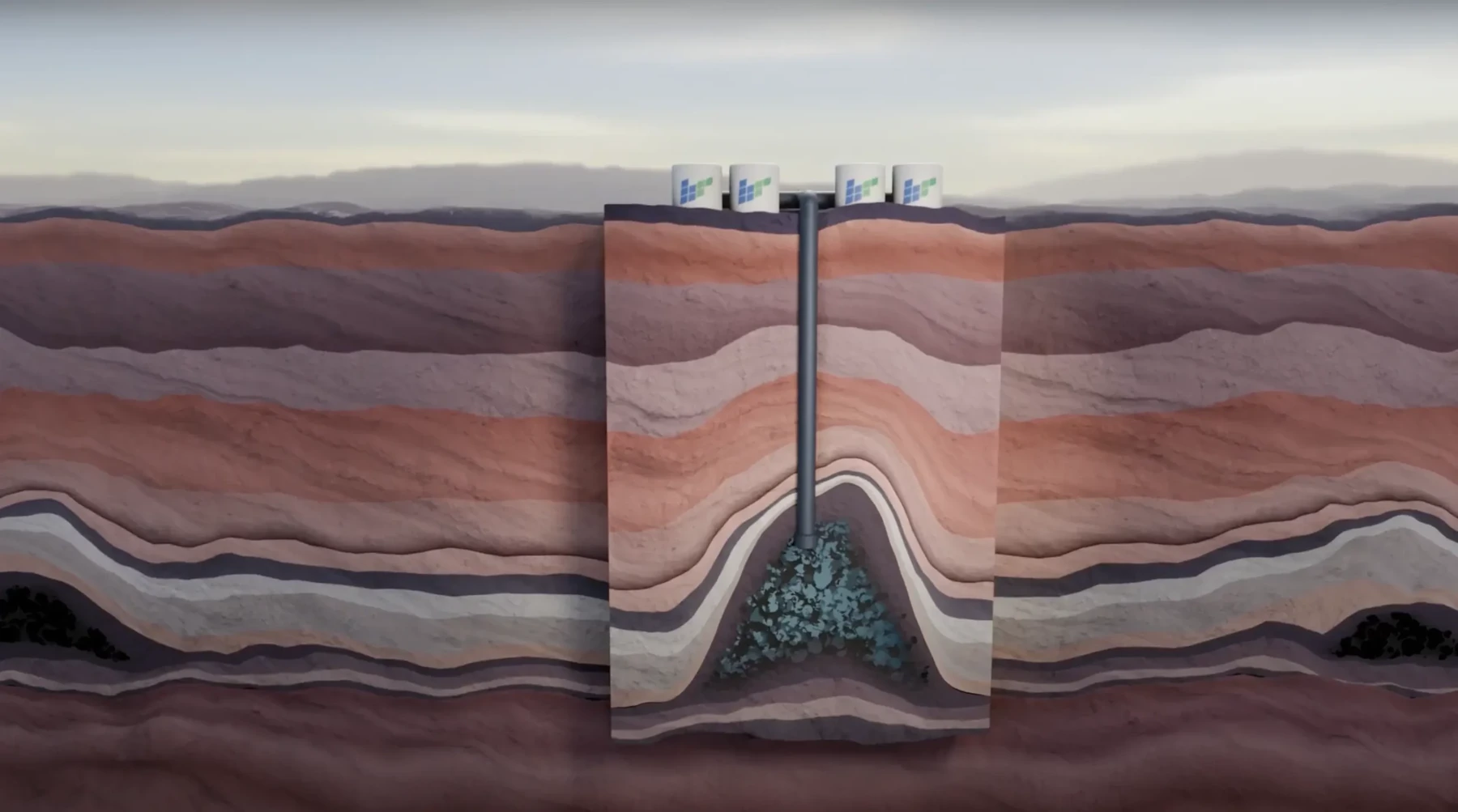
Bedrock’s storage already exists. Two depleted natural gas reservoirs more than 500 metres down – porous rock inside natural seals that held gas under pressure for 450 million years, well below the aquifers that supply local wells. One sits beside the plant. The other is some ten kilometres south, connected by its own buried pipeline. They were licensed for gas storage for decades before the Ontario Energy Board de-designated them in 2019.
Two pools also means two jobs. One carries compressed air. The other can be returned to natural gas storage, the use it was licensed for, and restoring those approvals is part of the plan.
How the storage cycle works
Flexible demand
Ontario regularly generates more electricity than it can use. Baseload nuclear does not stop at night, wind blows when the province is asleep, and the output that cannot be placed is constrained off – spilled, unpaid for, gone. Charging the reservoirs is somewhere for it to go. The compressors are a buyer the system currently does not have.
Long-duration storage
Compressing air makes heat, and heat is what most designs throw away. Here it is captured and held in insulated tanks beside the plant while the air itself goes underground. Nothing degrades while it sits. A reservoir can be cycled daily for decades without losing the capacity it had on the first day, which is not true of every storage technology sold as long-duration.
Responsive generation
When the grid wants it back, the air comes up and meets its own stored heat on the way to the generating trains. Nothing is burned to reheat it. And because the site is also a load, it can charge and discharge different assets in the same hour – importing to the compressors while exporting from the turbines, or serving the campus while selling capacity to the province.
Round-trip efficiency
Of every 100 units of electricity used to fill the reservoirs, about 66 come back to the grid.1 The two compressed air plants that have run for decades, Huntorf and McIntosh, return roughly 42 and 54, because they burn natural gas to reheat the air on the way out.2 Bedrock keeps the heat it makes while compressing and gives it back to the air instead. That is where the difference comes from, and it is why nothing is burned in the storage cycle.
Firm generation and fast response
Gas turbines cover what storage cannot: a week of still, grey weather in February, or an outage somewhere else on the system. They are designed from the outset to run on blended hydrogen and to accept carbon capture, so the asset has somewhere to go as both become practical rather than being stranded when they do.
This is the part of the plan that has changed most, and it deserves a straight answer rather than a quiet one. A campus that promises a customer firm power every hour of the year cannot be built on storage alone. The compressed air plant remains non-combustion. The turbines are what make a round-the-clock commitment honest, and what make it possible to build the storage and the renewables that do the rest of the work.
Batteries handle the duty measured in seconds. Without them the large machines spend their lives chasing the grid, running at part load where they are least efficient and wearing out faster. With them, everything else runs where it was designed to run.
The switchyard is the product
All four assets and the campus load terminate at a single Bedrock-owned 500 kV switchyard, connected to the provincial system through a new switching station on the corridor that already crosses the property. Two circuits reach it. If one is out of service the site keeps importing and exporting through the other, and any single asset can be taken out without disturbing the rest.
To the system operator that makes the campus one resource at one point of connection with one set of studies behind it, rather than four projects queuing separately. And because the lines are already there, no new transmission corridor has to be acquired across anybody’s farm to reach it. Connected land is the part of this that cannot be bought in a hurry, and it is the part Bedrock spent nine years assembling.
None of this is a first of a kind
Compressed air storage has run on underground formations since Huntorf in Germany in 1978 and McIntosh in Alabama in 1991 – some eighty years of combined operation between them. Gas turbines, grid batteries and 500 kV switchyards are ordinary industrial equipment made by firms that have been making them for a long time.
What is new is the arrangement, and the fact that the geology, the corridor and the regulatory groundwork were already in place before the first turbine was ever specified.
Read more about our approach
How the load is modelled before anything is built: Energy Analytics. How the capital is staged against it: Strategic Investment.
Sources
- MAN Energy Solutions for Bedrock Energy Corp., Operating Cycle Calculations Summary: Bayfield and Stanley Connected, Case 7, issued 9 November 2022. Overall round-trip energy efficiency of 66.9 per cent, net of auxiliary load, with the heat of compression held in thermal storage. A design projection for the compressed air plant, not measured performance. ↩
- “First Megawatt-Scale Isothermal CAES Completion”, POWER magazine, 1 November 2013. Efficiency of about 42 per cent at Huntorf, Germany, 1978, and 54 per cent at McIntosh, Alabama, 1991. ↩

Get in touch
Talk to Bedrock
Landowner, municipality, supplier or press: tell us who you are and we'll route you to the right person.
Contact us