
Strategic investment
Strategic Investment
Infrastructure with a fifty-year life is not financed the way a technology company is financed. It is staged, it is contracted, and the people who put capital into it want to see that the hardest work was finished before construction started. That is the case Bedrock makes.

The scarce asset is the connection, not the equipment
Turbines can be bought. Compressors, batteries and switchgear can be bought, from firms that have been making them for decades, with delivery dates you can put in a schedule. None of that is where projects of this kind fail.
They fail on land, on grid access and on consent – and those take years that cannot be compressed by spending more. Bedrock’s position is nine years of exactly that work: reservoir rights held since 2017, a site on an existing 500 kV corridor, a transmission feasibility study completed with Hydro One, and a technical feasibility application before the Independent Electricity System Operator. Capital arriving now is not asked to fund the discovery of whether a site exists. It is asked to build on one that does.
Everything that could be de-risked before construction has been. What is left is a build, and builds are something the capital markets already know how to price.
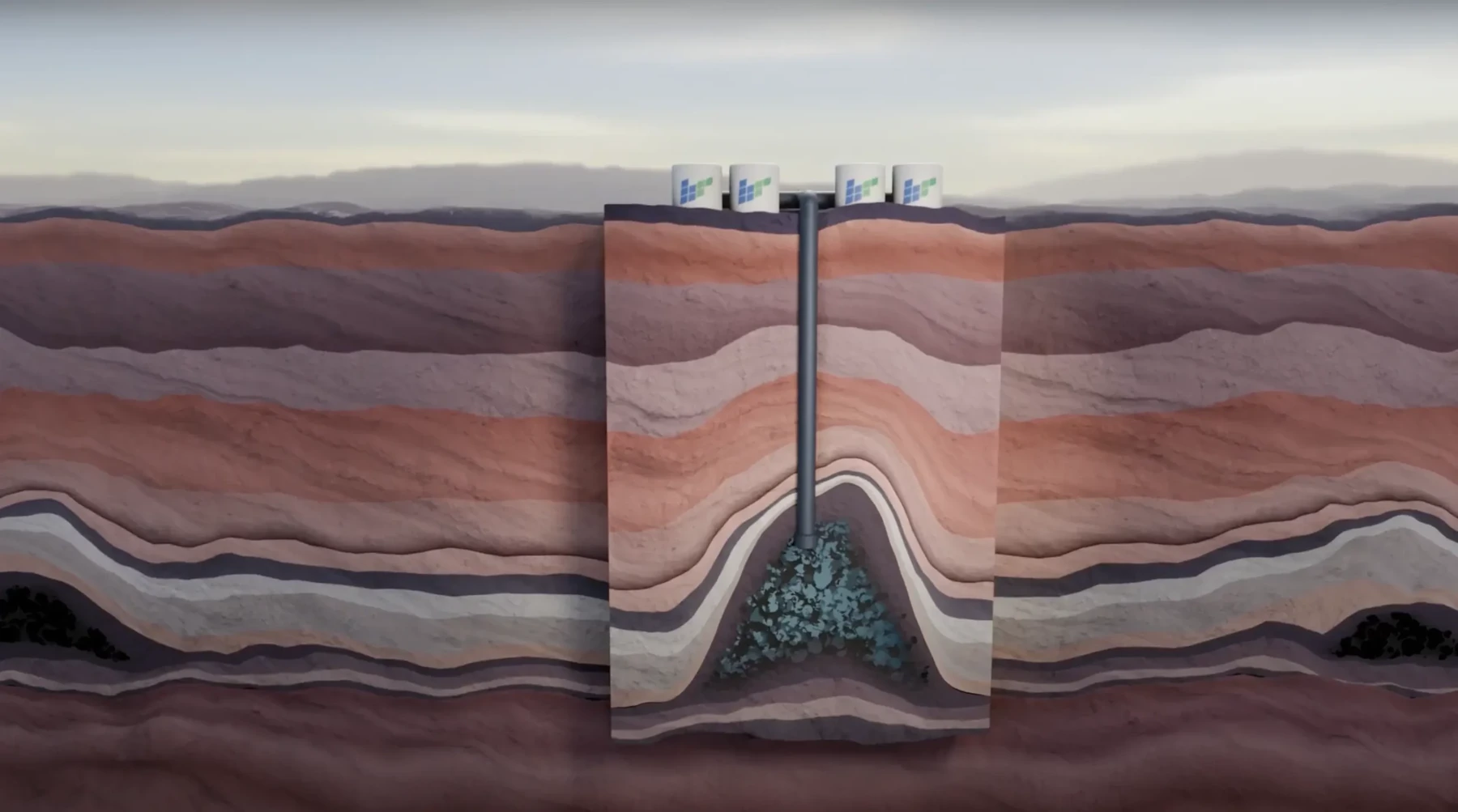
Phased, so nothing carries the whole risk at once
The campus is not a single switch thrown at the end of a decade. Batteries and the first modular phase come first, firm generation after, long-duration storage after that. Each phase stands on its own connection, each is permitted and financed on its own terms, and each earns before the next one is committed.
That sequencing is a financing structure as much as an engineering one. It lets the project meet investors with different appetites at the stage that suits them, and it means no single party is asked to underwrite the whole programme on day one. It also means the community sees the project arrive in steps it can judge, rather than all at once.
Built to own, not to flip
These are forty- to fifty-year assets. Bedrock’s intention is to own and operate them rather than sell at commissioning, which changes what the company optimises for in ways that are visible from outside.
An owner-operator has to live with the decommissioning obligation, with the water monitoring, with the road agreement and with the neighbours, for the whole life of the asset. A developer selling at the ribbon-cutting does not. When Bedrock offers a restoration bond or an independent review, it is offering something it will be standing beside in thirty years – and that alignment is the asset the host community is actually being asked to trust.
Powered land as a service
The simplest description of what Bedrock sells is land with power already on it. A developer that needs firm, round-the-clock electricity can build its own generation, wait in a connection queue and learn an industry it did not set out to join – or it can take supply by contract from a site where the generation, the storage and the connection already exist.
That model puts the capital where it belongs. Energy infrastructure is financed by people who finance energy infrastructure, on the terms and timescales that suit it. The customer gets certainty of supply without carrying a power project on its balance sheet. And because the site exports as well as supplies, the province is not asked to build a gigawatt of new capacity to serve a single private load.
How it has been funded so far
Bedrock is privately held and has been funded by its own shareholders since 2017. Nine years of reservoir work, land assembly, engineering, environmental assessment and regulatory filings were paid for before any public programme, procurement or offtake was in hand.
That is an unusual way to reach this point and it is deliberate. It means the project arrives at the capital markets with its geology proven, its corridor in place and its application filed, rather than with a plan to go and find those things.
Read more about our approach
What the capital builds: Infrastructure & Technology. How the load and the assets are modelled against each other: Energy Analytics. For anything else, write to us.

Get in touch
Talk to Bedrock
Landowner, municipality, supplier or press: tell us who you are and we'll route you to the right person.
Contact us