
Community
Q&A
These are the questions neighbours, councillors and reporters have actually asked. Where the answer has changed since 2023, it says so. Where we do not know yet, it says that too.

Questions and answers
The project put to Bluewater council in August 2026 was a storage plant. What Bedrock is developing now is larger and differently shaped, so several answers below are different from the ones given at the 2023 and 2026 open houses. The changes are flagged rather than quietly swapped.
Has the project changed since the council vote in August 2026?
Yes, substantially. The proposal that council refused was compressed air storage alone. What Bedrock is developing now is an integrated energy centre: long-duration storage, firm generation, batteries and a connected campus on one site, built in phases rather than all at once.
Why does the plan now include natural gas turbines?
Because a customer that needs power every hour of the year cannot be served by storage alone, and pretending otherwise would not survive contact with a cold, still week in February.
The compressed air plant still burns nothing. The turbines do. They are designed from the start to run on blended hydrogen and to accept carbon capture, and they run when the system needs them rather than continuously. We would rather state that trade plainly than repeat an emissions-free claim that no longer describes the whole site.
Is the site still the same size?
No. The earlier proposal described a footprint of about 120 acres. The plant site for the integrated project is 198 acres. Additional land is under option for the surface works, and the areas not built on remain in agricultural production.
When would it be operating?
Not on the timetable published in 2023. The current phasing is batteries and a first modular phase of the campus in 2029, firm generation in 2030, and compressed air storage in 2031. Those dates depend on the IESO study now under way, on approvals, and on municipal support that Bedrock does not currently have.
What happens to farmland that is built on?
Land not built on stays farmed. Land taken out of production is returned to agriculture when the project is decommissioned. Bedrock is willing to have that obligation written into a municipal agreement and secured by a bond, rather than left as an undertaking that depends on the company still existing in forty years.
Can Bedrock force a landowner to take part?
No, and Bedrock will not try. Participation is by agreement. A neighbour who does not want to be involved does not have to be. This was asked directly in 2023 and should have been answered in writing then.
Is there a risk to drinking water or private wells?
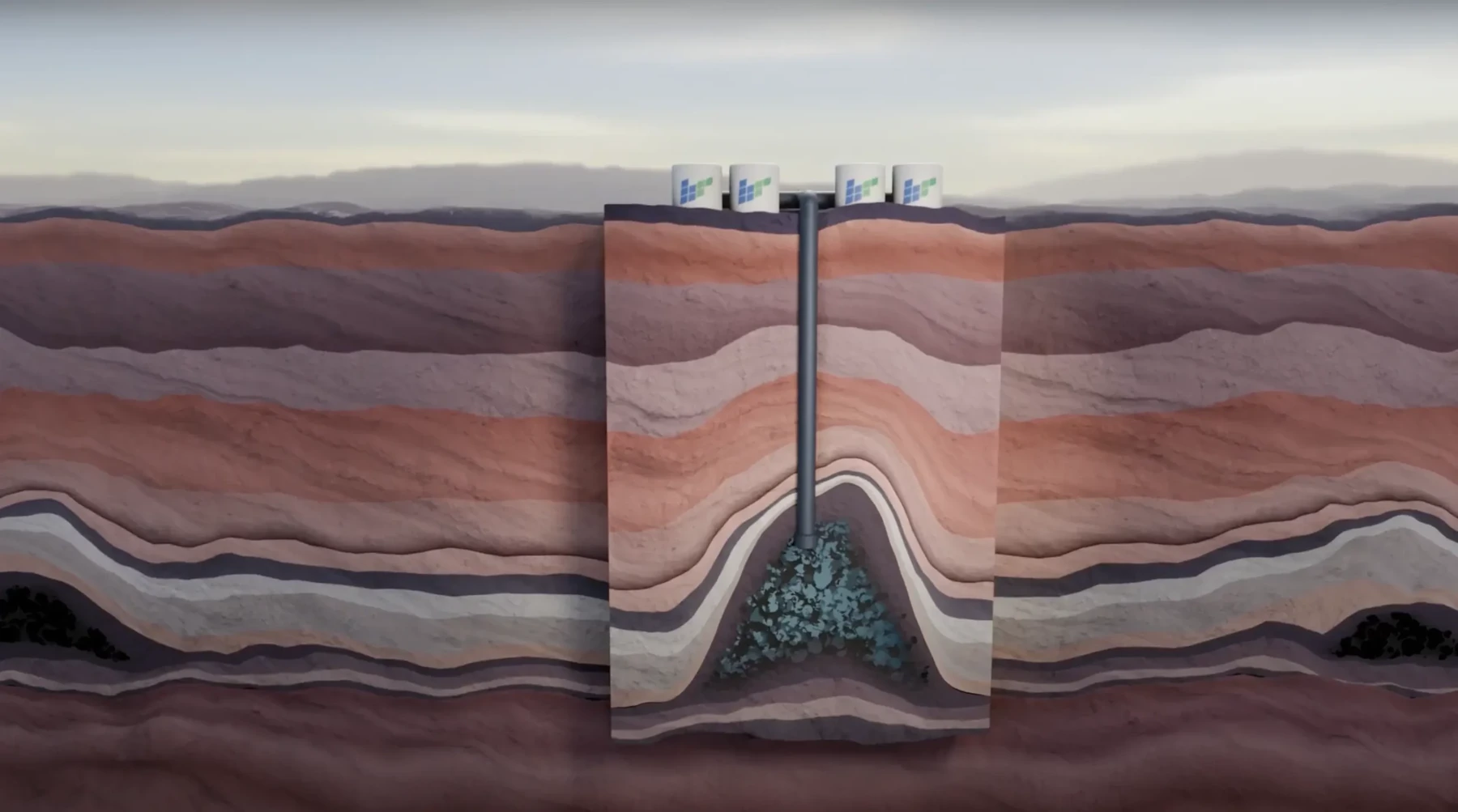
The reservoirs are more than 500 metres below the surface, well below the aquifers that supply local wells, and are separated from them by the same natural rock seals that held natural gas in place for millions of years. The wells reaching them carry multiple cemented casing strings.
That is Bedrock’s position, and Bedrock is not the right party to be the only one asserting it. We have offered an independent review of the reservoirs by a reviewer the municipality helps choose, published in full whatever it concludes, and baseline testing offered free to neighbouring wells.
How noisy is it?
Noise is assessed under the provincial environmental approval process, which sets limits at the nearest homes rather than at the fence. Measured predictions for the integrated project are being produced as part of that work and will be published when the assessment is complete, with the modelling behind them.
We are not repeating the decibel figures given for the earlier, smaller plant. The plant has changed; the numbers have to be redone.
What will it look like from the road?
Industrial buildings, a switchyard and transformer bays, with earthen berms and planting at the perimeter. There is no above-ground air storage: the air is underground. Lighting is specified to dark-sky standards so it does not carry across the fields at night.
How much traffic will construction bring?
Enough to matter, over several years. Bedrock is bringing a Road Users Agreement to the municipality that identifies the routes, commits to maintaining and repairing them, and keeps construction traffic off the roads through the villages where there is an alternative.
What does the community actually get?
A Community Benefits Agreement, with property taxes at the industrial rate on top of it. What that agreement is worth and who governs it are being worked out with the municipality rather than set out here ahead of an agreement.
How many jobs?
Several years of construction employment and permanent operating roles, and we are not putting a number on either yet.
The earlier, smaller proposal published figures of its own. This project is larger, but until the phasing is fixed any number would be a guess. Shifting numbers were one of the fair criticisms made of this project in 2026, and we would rather publish late than publish wrong.
Has this been done anywhere before?
Compressed air storage has operated on underground formations since 1978 at Huntorf in Germany and since 1991 at McIntosh in Alabama. What is new here is using depleted gas reservoirs rather than an excavated cavern, which is why the regulatory pathway is being confirmed with the province rather than assumed.
Bedrock’s would be the first project of its kind in Canada. We would rather say that plainly than describe it as routine.
Is this the only project Bedrock is working on?
No, and the previous version of this page said otherwise. Bedrock holds a second reservoir position at Stanley, and intends to develop further sites. Bayfield is the first and the most advanced.
Does the project need a new transmission line?
No. Two 500 kV circuits already cross the site. That is the reason this location was selected, and it means no corridor has to be acquired across neighbouring farms to connect the project.
What is the data campus, and is a tenant signed?
The campus is a large continuous electricity customer located on the same site as the generation that serves it. Discussions with prospective operators are under way. No agreement has been signed, and anyone telling you a tenant is confirmed is ahead of the facts.
How much water does it use?
Water for cooling and servicing is being worked through as part of the design and the environmental assessment, and the figures are not settled. When they are, they will be published alongside the assessment rather than quoted in advance.
What happens at the end of the project’s life?
Wells are decommissioned under the provincial well-licensing regime, with a bond held per well. Surface works are removed and the land restored to agriculture. Bedrock has proposed that the municipality hold security for this rather than rely on the company’s undertaking.
Does the project receive public subsidy?
Development to date has been funded privately by Bedrock’s shareholders. Like any Canadian clean-energy project, the built asset may qualify for federal investment tax credits; eligibility is being confirmed with tax counsel and will be stated once it is settled.
What approvals are still outstanding?
A connection assessment with the IESO and Hydro One; environmental approval from the province; well licensing; confirmation of the regulatory pathway for air storage in these reservoirs; zoning and site plan approval from Bluewater; and a municipal resolution of support, which is mandatory for an IESO contract.
Are First Nations involved?
Consultation with five First Nations is under way as part of the environmental assessment. Bedrock is open to equity participation and has said so to the communities directly. Their positions are theirs to state, not ours.
Where can I see the technical detail?
Operating pressures, storage volumes, efficiency, equipment selection and the engineering drawings are documented for regulators, reviewers and counterparties. They change as the design matures, which is exactly why publishing a snapshot of them here has caused problems before. If you want that level of detail, as a resident, a councillor or a reporter, ask us and we will arrange it.
Who do I talk to?
Questions asked publicly get answered publicly, including the uncomfortable ones. Use the contact form and say who you are, and it will reach the right person rather than a general inbox.

Get in touch
Talk to Bedrock
Landowner, municipality, supplier or press: tell us who you are and we'll route you to the right person.
Contact us